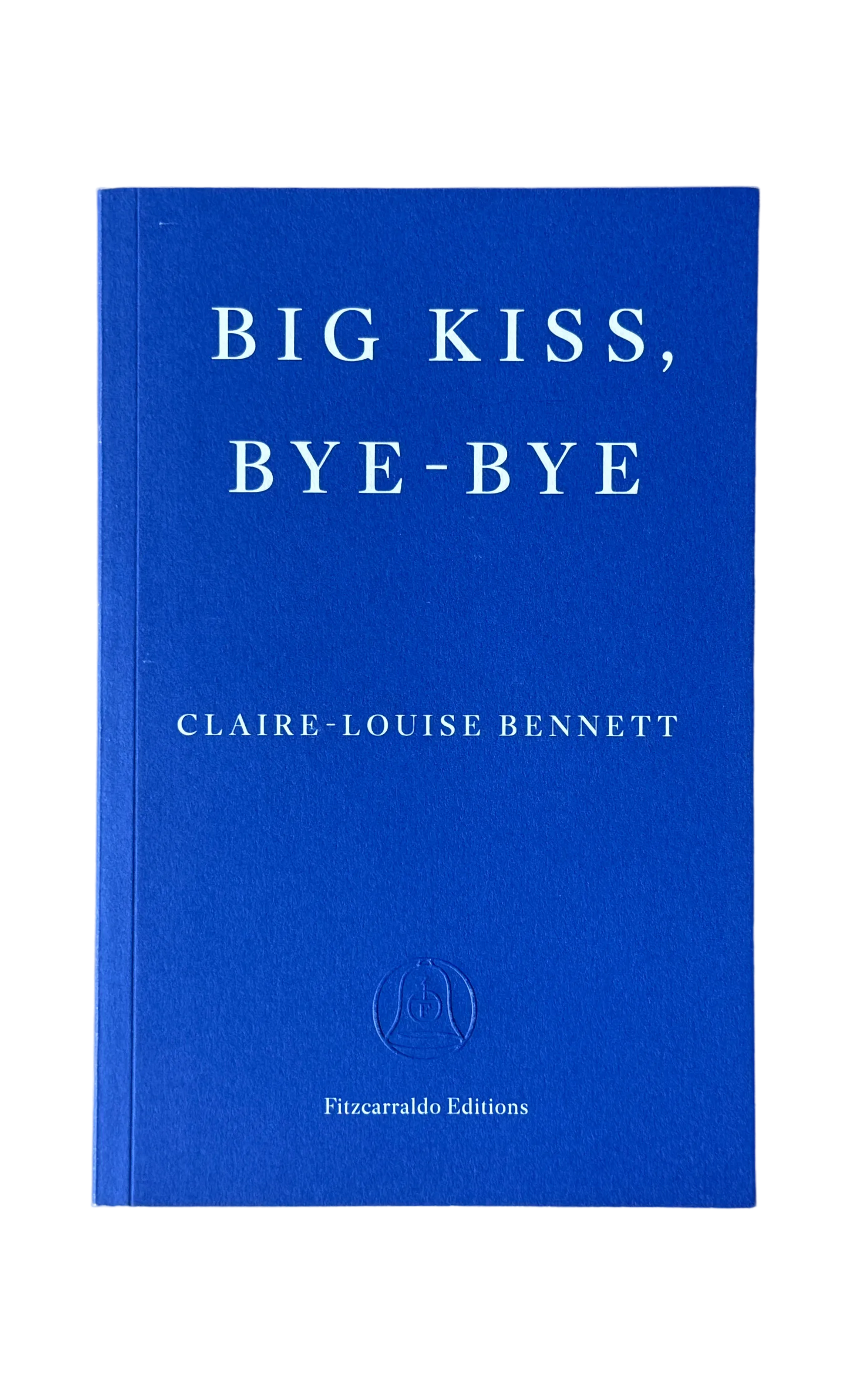
Big Kiss, Bye-Bye
by Claire-Louise Bennett
Bennett’s writing about love and memory catches you mid-air.
“Comments will be made, and eventually, if the procurement of outlandish flowers persists, questions, I’m sure, will be asked. How will I explain them? ‘There’s a man,’ I’ll say ‘who likes me to always have flowers. He sent me them regularly for years when I lived in the old place, and now he’s found a way to make sure I never go without any while I am here.’”
Where Bennett’s Pond, which I’ve written about before, reads like a collection of short stories, or vignettes, Big Kiss, Bye-Bye is closer to the diary of an unnamed narrator, who lives in a temporary limbo. She’s moved to a shed in the Irish countryside, and spends the book’s 158 pages revisiting memories, mostly of Xavier, an older man she loves but no longer desires. She hasn’t told him where she’s gone, and (or because) he does not want to accommodate her wish to be alone (“I will not exchange my LOVE for friendship”, he writes to her—emphasis his).
She writes about their correspondence—her exchanges with this now much older man, near dying—and mixes in her memories of their time spent together, retracing the steps of their travels and rehashing their conversations. Or, of the flowers he had her buy on his dime: he had an account at the flower shop, and she had a minimum spend of—she thinks—fifty euros per week, which always seemed to be too much. If she didn’t hit the fifty, it would accumulate, turning the act of buying herself the flowers that her lover wanted her to have into some kind of to-be-dreaded event.
Alongside her post-breakup correspondence, she receives an unexpected letter from a previously forgotten professor, Terence Stone, who got through to her via her publisher. He found her latest book in his local library and, having read it, he sends her his compliments. Hesitant to reply at first, she does start an exchange with him, and their writings pop up throughout, triggering waves of memories, most of them unwelcome.
I’ll admit she can be a bit hard to follow, Bennett. If you’re not in the right mind, it must be difficult to let yourself be taken by the current of her writing, which ebbs and flows, often interrupting itself mid-sentence. The narrator’s memories appear as murky, or fully formed; thoughts bubble up or flutter away, sometimes repeat themselves; conversations accurately reflect the state of mind of their participants. For me, the dialogues as well as the interior monologues, as she puts them to paper, are all a thing to admire.
Take a sex scene, early in the book, set in London’s financial district, that breathlessly stammers forward:
“Sizeable corinthian columns. Broad enough for us to disappear behind. The grooves of the column right behind me and one leg, the left leg, lifted, lifted up and out. The shoe gaping midair, possibly seen. [...] The crotch of my knickers, black. The black crotch I take hold of either side and pull across, or perhaps he did that. Yes, he did that.”
Reading it in full (it’s five pages!) is not so much reliving it, but more akin to remembering it. “Or perhaps he did that”—memories of that day (those minutes? seconds?) fade in and out as the narrator writes them down, losing her footing sentence by sentence. Even punctuation marks disappear as the writing—and the act its subjects were caught in, absorbed by—drives forward and forward, time melting before your eyes as the words rush by. It’s a riveting bit of writing that, when it arrives, pours in—much like all of the memories the unnamed narrator attempts to capture: unsolicited, presumptuous and entirely disorienting.
Not so different from all those fucking flowers.
“All in all though I’m beginning to realise I don’t like receiving flowers, not from anyone, not for any reason. Maybe one day when I live in a house of my own it will be alright. But until then it seems I find their unbidden arrival into my precarious world intrusive, presumptuous and increasingly disorienting.”
Big Kiss, Bye-Bye by Claire-Louise Bennett
Published by Fitzcarraldo Editions in 2025