Frog and Other Essays
by Anne Fadiman
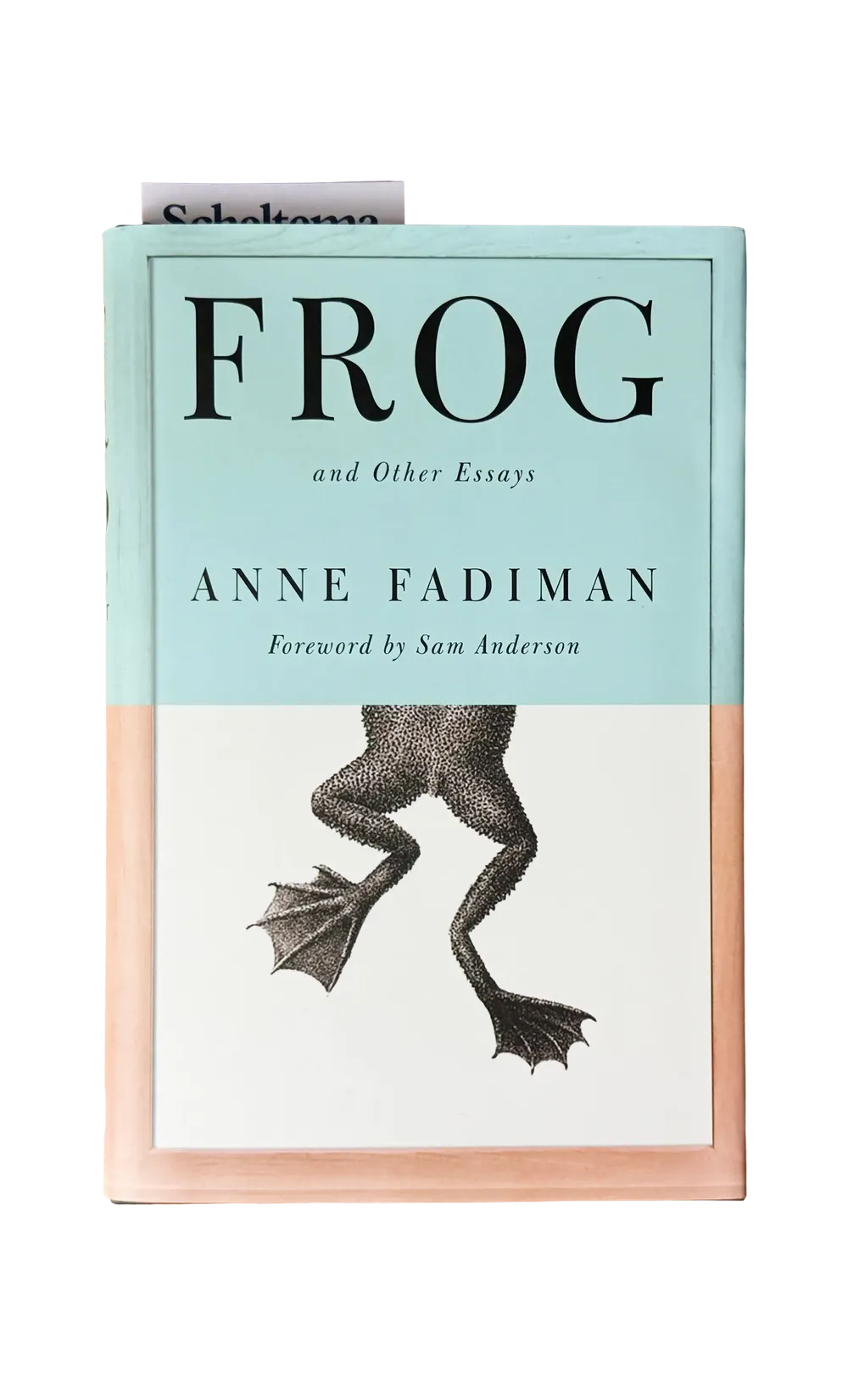
A frog in the freezer, an immortal printer, and a new Yiddish word for Zoom fatigue: on Anne Fadiman’s latest collection.
What I like about reading a great collection of essays is how it can pull you in and, to borrow an image from Virginia Woolf, draw its curtain around you. How, in a great collection of essays, each essay becomes its own little expedition, and for the duration of that expedition nothing exists outside of it.
A great writer will refer elsewhere, let you peek through the curtain now and again to heighten your anticipation and appreciation for what’s out there, but, for the most part, keeps you cocooned. The writing of Joan Didion comes to mind. Zadie Smith, of course. But so too do Jo Ann Beard and Elisa Gabbert, as previously recommended in this publication. And now, Anne Fadiman. In Frog and Other Essays, published this year, are seven essays, swinging from the historical (on Hartley Coleridge, and The South Polar Times) to the mundane (frogs, printers, Zoom).
There’s the titular essay on her family’s pet frog Bunky, who lives with them, undisturbed and largely unnoticed, for many years. Inevitably, at some point Bunky passes away, and Fadiman and her husband agree to wait until their children—both moved out—are home again, before they bury him under the weeping cherry.
“We filed Bunky’s Ziploc at the back of the second shelf from the bottom. Sometimes we worried that a guest might find him while rummaging for the English muffins and become alarmed. But mostly we didn’t think of him at all. It’s easy to forget you have a frog in your freezer when he’s behind the frozen tamales.”
Is it strange to have a frog in your freezer? Yes. Does it make perfect sense within the confines of the piece? Also, yes.
There’s a great essay on Fadiman’s printer, the Hewlett-Packard LaserJet Series II—a device she clung to for decades after its discontinuation, and kept alive with parts cannibalised from its fallen brethren. (Flipping through the pages of the book again while writing this, I realise “My Old Printer” only takes up ten of them, yet it feels—and this is a compliment—like I’ve spent a life with that old machine.) “All My Pronouns”—on the long search for a gender-neutral singular in English, and on Fadiman’s students who live outside the binary—is perhaps the most thoughtful writing on the subject I’ve read.
And then there’s the closing “Yes to Everything”, a beautiful and sad but life-affirming essay on Marina Keegan, a student of Fadiman’s who died in 2012, five days after graduating magna cum laude from Yale University.
“I was familiar with some of the pieces because she’d written them for my class. As I started to read the rest—a profile of an exterminator called “I Kill for Money,” an essay on why so many of her classmates were forgoing creative work and taking jobs in finance, a short story about a woman who thinks her Chinese ankle tattoo means “inner resolve” but finds out it really means “soybean”—I was astonished by the range of her subjects and the strength of her voice.”
Keegan’s own collection of essays and stories, The Opposite of Loneliness—published posthumously in 2014—became a New York Times bestseller.
Throughout her writing, Fadiman strikes a tone that is expertly balanced. She’s sharp, witty, sincere, and above all, whenever appropriate, very funny. “Screen Share”, her essay on the pandemic, is thoughtful and hilarious. It recounts her coming to terms with Zooming to keep teaching her nonfiction writing classes to her students, rather than doing so in person inside a classroom (preferably Linsly-Chittenden 212, “a tiny room in a faux-Gothic hall built in 1907”). She zigzags between the everyday (“It’s touching to hear Pulitzer Prize winners share cyber tips”) and the existential:
“Another weird thing: I can see myself while I’m teaching. It’s as if when I taught in Linsly-Chittenden 212, a small mirror had been positioned in front of my face at all times. I’m mesmerized. How have I lived for sixty-six years without knowing that when I talk, the right side of my mouth is lower than the left?”
A friend, a teacher at another university, tells her that a new Yiddish word has been invented to signify your overexposure to Zoom: oysgezoomt. “Ich bin azoy oysgezoomt!”
If you’re feeling oysgezoomt yourself, I recommend you let Fadiman draw the curtain around you.
Frog and Other Essays by Anne Fadiman
Published by Farrar, Strauss and Giroux in 2026