The Wild Birds
by Wendell Berry
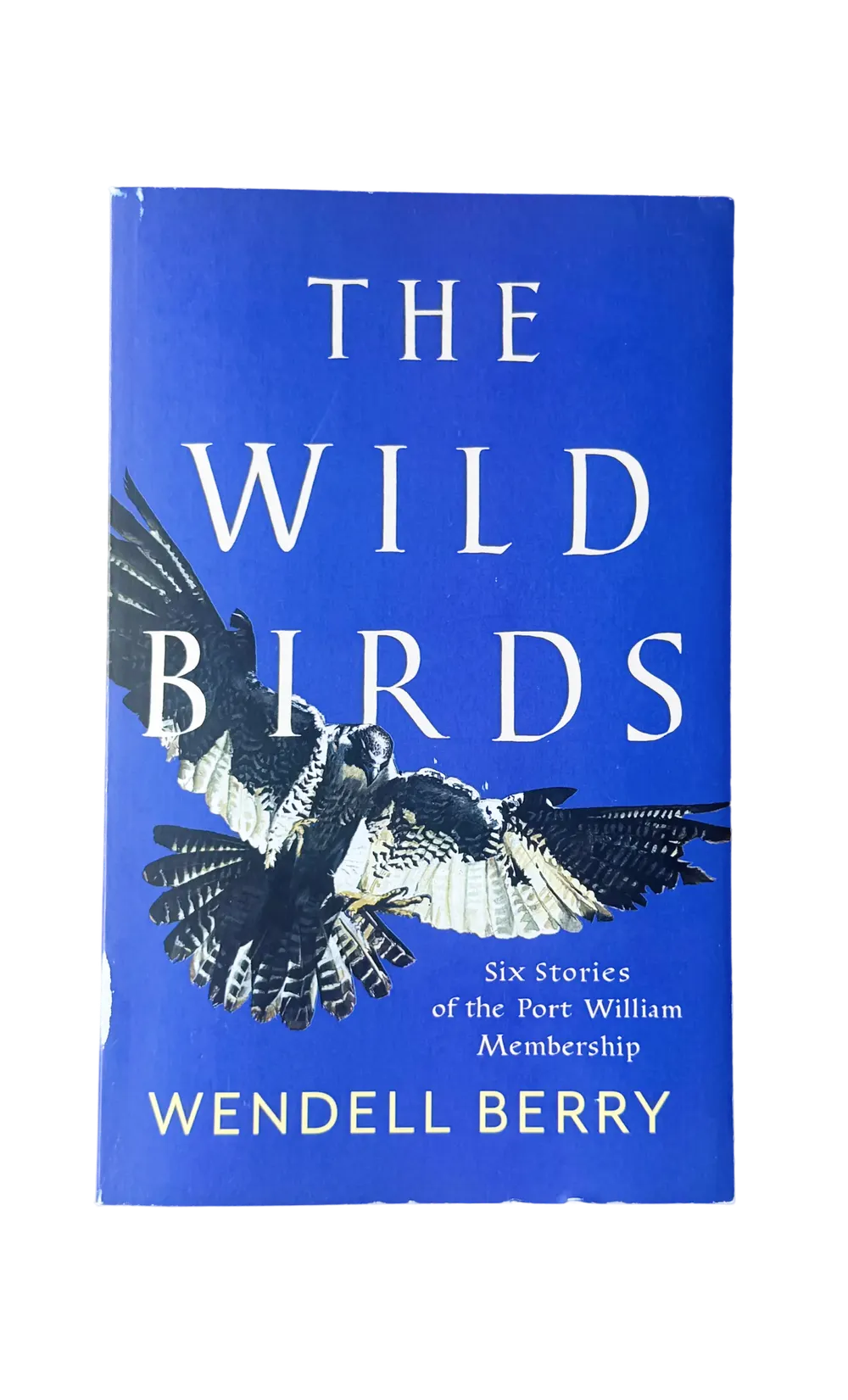
Six interlinked stories, warm and unhurried, from a fictional Kentucky town.
During a recent visit to Louisville, Kentucky, I stopped in at Carmichael’s on Bardstown Road. In business since 1978, it’s reputedly Louisville’s oldest independent bookstore. Whenever I’m abroad I like to visit one such bookstore, to buy a book by a local writer (though, on a recent trip to Stockholm I made an exception: the international collection at Söderbokhandeln Hansson & Bruce, established in 1927, is just too good).
The Carmichael’s employee I asked, eyes shining, steered me towards Wendell Berry, perhaps the writer Kentucky is fondest of. At ninety-one he is celebrated for his essays, novels and poetry, much of it turning on rural and agrarian themes. I took her advice and picked up a recently republished collection of his short stories, The Wild Birds.
 Amanda Petrusich
The Wild Birds spans three decades of life in Port William, a fictional community in Kentucky’s river-valley farm country that forms the recurring setting of Berry’s novels and stories. The particular stories in this collection revolve around Wheeler Catlett, a lawyer whose clients are also his friends and neighbours, and whose roots are planted firmly in that Kentucky soil.
At 158 pages, the collection makes a gentle introduction to Berry’s work. With stories taking place between 1930 and 1967, his account of country life is warm and affectionate. In just a few pages he conjures characters complex enough to justify placing a family tree in the back pages, and a map of the township beside it—you won’t need either, but they show just how much Berry cares about this world he imagined.
The stories move chronologically through the life of the community, and two in particular stood out to me: Thicker Than Liquor and The Boundary. In Thicker Than Liquor we meet Uncle Peach, Wheeler’s uncle, whose drinking problem get him into every kind of trouble.
“When he worked, which was far from all the time, Uncle Peach was a carpenter, and for a while he was known as a good one. His failing in his younger years was merely infidelity. He was absolutely dependable as long as his pockets were empty. Money made him thirsty; once he got thirsty, he left; and then there was no getting him back until he had passed through flight, gallantry, drunkenness, devastation, and convalescence.”
Wheeler often is left to sort him out or settle whatever debt he owes, and travels to Louisville to do just that. It’s a comic, slightly melancholy portrait of family duty—of loving someone who can’t be relied upon. It quietly sets the book’s tone, too: in Port William people are bound to one another, whether they like it or not.
In The Boundary we follow Mat Feltner, an elderly man walking his farm’s fence line on a warm day because, he realised, it had been years since he did.
“But when he came out onto the porch and sat down and lit his pipe, a thought that had been on its way toward him for several hours finally reached him. He does not know how good the line fence is down Shade Branch; he would bet that Nathan, who is still rushing to get his crops out, has not looked at it. The panic of a realized neglect came upon him.”
After dinner, to his wife’s surprise, Mat forgoes his nap to walk that length of the boundary line that runs down Shade Branch.
“He has it all before him, the place that has been his life, and how lightly and happily now he walks out again into it! It seems to him that he has cast off all restraint, left all encumbrances behind, taking only himself and his direction. He is feeling good. There has been plenty of rain, and the year is full of promise. The country looks promising.”
As he sets out, his mind drifts and memories surface: a walk he has made many times before becomes a meditation on age, and his lifelong bond with the land. The walk out is easy enough; the walk back nearly kills him. What carries him is the land itself, and the memory of everyone he ever worked it with. Nothing much happens, and that’s the point: Berry lets a single afternoon hold a whole life.
The four other stories work in much the same key, and I left Port William the way I gather Berry’s readers tend to: a little homesick for a place I’d never visited, and thankful that Carmichael’s in Louisville had sent me home in such good company.
The Wild Birds by Wendell Berry
First published by North Point Press in 1986
Published by Counterpoint in 2019