Any Person Is the Only Self
by Elisa Gabbert
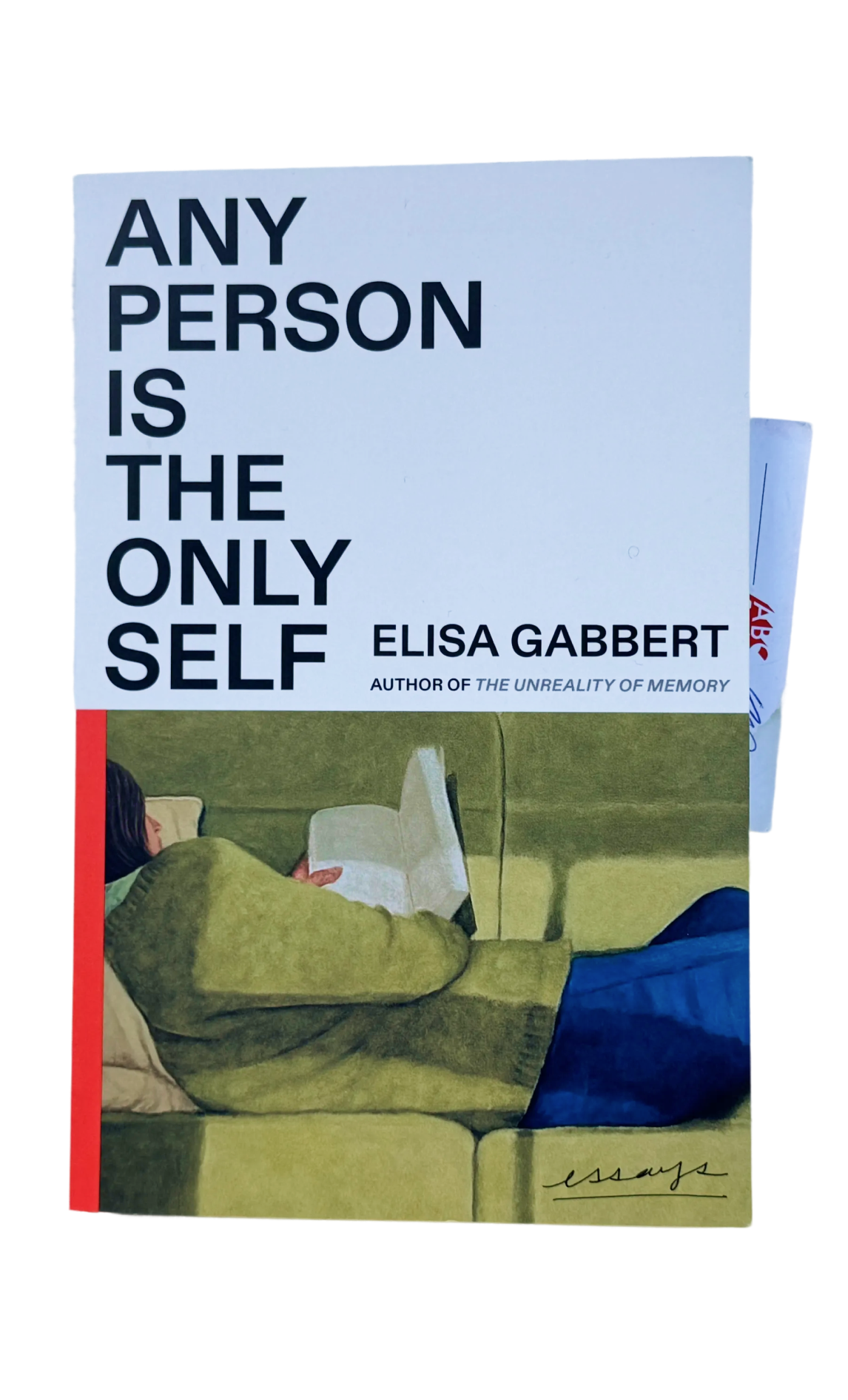
A generous collection of essays on reading, writing, and the quiet pleasures of literary life.
At the centre of this collection is an essay called Second Selves, which starts by outlining examples of people who suffer from highly superior autobiographical memory, or HSAM. It's a rare condition, and the people afflicted have a near perfect memory. She writes:
“If you throw them any date from their conscious lifetimes, they can tell you what day of the week it was and any major events that took place in the world; they can also tell you what they did that day, and in some cases what they were wearing, what they ate, what the weather was like, or what was on TV.”
It's a great essay, one in which Gabbert meanders from memory to journaling (one of the hyperthymesiacs, as they're called, kept them religiously), and highlights journals kept by writers like Susan Sontag, Virginia Woolf, and Sylvia Plath.
“I'm interested in the journals of writers (I suppose anyone who writes journals is a writer) as sites of self-loathing, of disappointment and failure”.
That’s what she does: most of the collection circles back to writing, to writers, to reading and books, and to the community (or sense thereof) they provide. Quite a few harken back to the pandemic, to a longing for connection (or literal “skin hunger”) that was difficult to satisfy if it wasn't for books, and the lives lived within them.
Most of the essays feel light, even fun. The opening essay concerns recently returned books in the library, an unvetted shelf that presents a perfect cross section of what a library has to offer.
“Sometimes, when I was in a hurry, it was the only shelf I looked at. There were art books and manga, self-help and philosophy, biographies and thrillers, the popular mixed up with the very obscure. I liked how it reduced the scope of my options, but without imposing any one person's taste or agenda upon me, or the generalized taste of the masses suggested by algorithms.”
There's an essay about a Stupid Classics book club (“read all the corny stuff from the canon that we really should have read in school but never had”), one on Frankenstein, one on Proust (“Everyone says you should read Proust, of course, but no one had ever told me, specifically, that I should read Proust”). And, one of her best—Somethingness (or, Why Write?)—on the joy of writing, or the why of writing, where she pulls together (and relates to or pokes fun at) a great big group of writers and their reasons for doing what they do.
There are a few essays that felt a little tight, like she was trying to squeeze them into a mould they had no business of fitting into. When she doesn't try too hard though, her writing brims with a self-assured nonchalance. Her essays then dance off the page, are often funny, and never snobby. They pull you in with an idea, thought, or observation, and when you leave them you're left wanting to dig down deeper, for more.
She often negates making ‘a point’, or leaving you with a clear conclusion. Instead, with every essay, it's her personal experience that lingers most after you finish reading it—like flashes on your retina—as if you've been offered a glimpse inside her own memory or journals. She left me feeling grateful for those glimpses, newly excited about literature, and hungry for reading more of her work.
Any Person Is the Only Self by Elisa Gabbert
Published by Farrar, Straus and Giroux in 2024